Meet “The Worm”: How Incline Village Is Creating a Stronger Defense Against Wildfire
If you live in Incline Village—or have driven along Mt. Rose Highway recently—you may have heard people talking about “The Worm.”
Despite the unusual name, The Worm is actually a significant wildfire fuels reduction project designed to create a stronger buffer between our neighborhoods and the surrounding forest.
And with wildfires once again reminding Northern Nevada and the Lake Tahoe region how quickly conditions can change, the work happening above Incline Village couldn't be more timely.
So, What Exactly Is “The Worm”?
The Worm Wildfire Fuels Mitigation Project is a partnership led by the North Lake Tahoe Fire Protection District (NLTFPD) with the Incline Village General Improvement District (IVGID), Nevada Division of Forestry, U.S. Forest Service and other partners.
The project gets its memorable nickname from the long, winding shape of the treatment area as it follows the boundary between residential neighborhoods and forestland above Nevada State Route 431—Mt. Rose Highway.
When completed, the project will encompass approximately 176.5 acres of wildfire fuels treatment. Its purpose is straightforward: reduce the vegetation that can carry wildfire toward our neighborhoods while creating an area where firefighters have a better opportunity to safely and effectively defend homes and infrastructure.
The treatment extends approximately 132 feet from private property boundaries into surrounding forestland, creating an intensively managed buffer around portions of the community.
How Does It Work?
One of the most interesting parts of The Worm is the equipment being used.
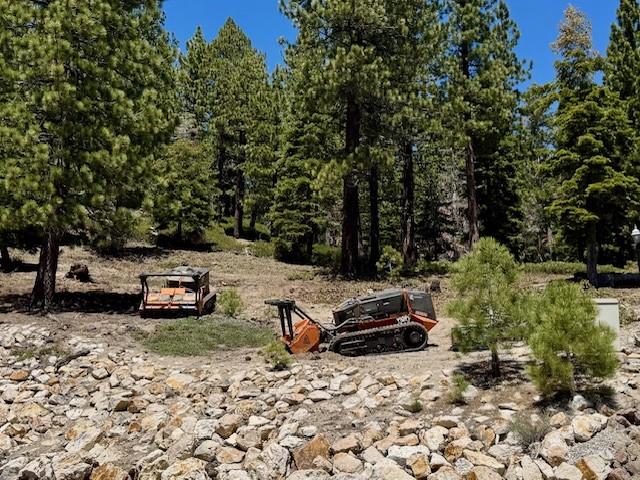
NLTFPD is working with BurnBot, whose remotely operated mastication equipment can travel through the forest and essentially chew up smaller vegetation and other hazardous fuels.
Rather than operating the machinery from inside a traditional cab, operators control the machines remotely. This gives them a broader view of the surrounding terrain while the lighter equipment helps minimize disturbance to the forest floor.
The machines work alongside hand crews to thin understory vegetation, remove smaller suppressed trees and break up concentrations of combustible material.
The resulting material is spread across the forest floor rather than simply being piled in one location.
The goal isn't to clear-cut the forest. Approximately 10–15% of the native brush is intentionally retained in a mosaic pattern to help preserve wildlife habitat, soil stability, water quality and the natural appearance of our Tahoe forest.
Why Does Reducing Fuels Matter?
Wildfire is a natural part of the Sierra Nevada ecosystem. The challenge occurs when dense vegetation allows fire to move rapidly through the forest and toward homes.
Removing excess brush and smaller vegetation can reduce the amount of fuel available to a wildfire.
That can mean:
- Lower fire intensity as flames approach neighborhoods
- Better access and working conditions for firefighters
- Reduced ladder fuels that can carry fire into tree canopies
- Greater separation between heavier forest fuels and homes
- Improved opportunities for firefighters to defend neighborhoods and critical infrastructure
As NLTFPD Forester Jason Furmaniak explained in the recent report, the project is bringing high-quality wildfire fuels reduction right up to the boundary of private property and extending 132 feet into the forestland.
That is an important piece of community wildfire protection.
Phase One Is Complete. Phase Two Is Underway.
The first phase of The Worm was completed in July 2025, treating approximately 62.6 acres.
Phase Two began in July 2026 and encompasses approximately 113.9 additional acres, bringing the entire project to approximately 176.5 acres.
Approximately 35 acres of Phase Two had already been completed as of mid August, with work scheduled to continue through mid-September.
Funding is also a collaborative effort.
IVGID fully funded Phase One. Phase Two includes funding through a State of Nevada A.B. 578 Better Together Nevada Shared Stewardship Grant, a U.S. Forest Service Hazardous Fuels–Community Protection Grant, IVGID matching funds and a stewardship agreement between NLTFPD and the USDA Forest Service Lake Tahoe Basin Management Unit.
It's a great example of local, state and federal resources coming together for one very important goal: protecting our community.
The Worm Is Only One Piece of the Puzzle
Perhaps the most important takeaway for homeowners is that community-scale fuel reduction doesn't replace defensible space around individual homes.
It complements it.
The equipment working on The Worm cannot simply move onto private residential property. Once you reach the property line, wildfire preparedness becomes a shared responsibility between agencies and homeowners.
That means maintaining defensible space, managing vegetation, removing combustible debris and looking at the home itself for vulnerabilities—particularly from wind-driven embers.
As one Incline Village resident said while watching The Worm project near his neighborhood, homeowners still have an important job to do: make sure an ember landing on their property doesn't become a house fire—or ultimately a neighborhood fire.
That is an excellent way to think about wildfire preparedness.
The Worm helps protect the neighborhood. Defensible space and home hardening help protect the individual home. Together, they create layers of protection.
Protecting What Makes Incline Village Special
Those of us who live in Lake Tahoe understand the balance involved in forest management.
We want healthy forests. We value our trees, wildlife, trails and beautiful natural surroundings. At the same time, living in the wildland-urban interface means accepting that wildfire preparedness must be an ongoing part of caring for our community.
The Worm is particularly interesting because the project isn't designed to remove everything in its path. Instead, crews are selectively reducing hazardous vegetation while retaining native brush and working to protect soil, water quality, wildlife habitat and the character of the forest.
It is forest stewardship and community protection working together.
A More Wildfire-Ready Incline Village
No single project can eliminate wildfire risk in the Lake Tahoe Basin.
But projects like The Worm can make a meaningful difference.
When you combine large-scale forest fuels reduction with defensible space, home hardening, evacuation preparedness and responsible forest management, you begin creating something much more powerful: a community that is better prepared before the next wildfire starts.
The Worm may have started as a nickname based on a funny-looking line on a map, but it represents something much bigger.
It's another layer of protection around Incline Village—and another example of the proactive work being done to help protect our homes, our forests and the community we love.
Learn More
For current information about The Worm, wildfire preparedness, defensible space inspections and other fuels-reduction programs, visit the North Lake Tahoe Fire Protection District website.
You can also watch the recent 2 News Nevada report, which provides an excellent look at the remote mastication equipment operating in the forest and explains how Phase Two of The Worm is progressing.